 |
| Compare the best government engineering colleges in Maharashtra based on fees, placements, scholarships, and CAP admissions for 2026. |
Which Government Engineering College in Maharashtra Offers the Best Value in 2026?
Every June, thousands of Maharashtra students open their MHT CET scorecard, feel a rush of pride, and then quietly panic. A strong percentile means options — but private colleges quoting ₹1.2–2.5 lakh per year make many families assume quality carries a price tag they can’t afford.
Here’s the insight almost every “lowest fee” article gets wrong: Maharashtra’s DTE sets government-college tuition within a fairly narrow band, so one government college is rarely dramatically “cheaper” than another. What actually decides your final bill isn’t which college you pick — it’s your category, TFWS eligibility, and MahaDBT scholarships. That’s how a ₹80,000 advertised fee becomes ₹20,000 net for one student and near-zero for another.
This is a selection handbook, not a Top-10 list. You’ll learn what you’re really paying for, verified 2025–26 fees, cut-offs, and exactly how to shrink your net cost.
Quick Takeaways
- Base tuition is similar across government colleges — DTE sets it in a narrow band, so no single college is dramatically “cheaper.”
- Your category + scholarships decide your real fee, not the college. TFWS and MahaDBT can cut it 50–100%.
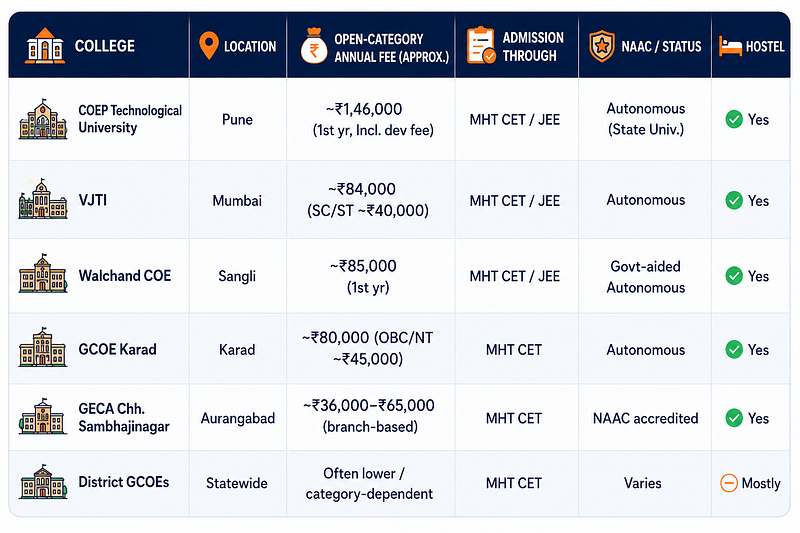
- Verified 2025–26 open-category fees: COEP ~₹1.46L (highest), VJTI ~₹84k, Walchand ~₹85k, GCOE Karad ~₹80k, GECA Aurangabad ~₹36k+ (lowest).
- Top cut-offs (2025, CSE, General): VJTI ≈99.95 percentile, COEP ≈99.67–99.90.
- Best strategy: pick the highest-ROI college your percentile allows, then apply for every scholarship you qualify for.
💡 Did You Know? A student eligible for both TFWS + MahaDBT can pay almost zero tuition at a government college — turning a ₹80,000 sticker fee into a few thousand rupees of incidental charges.
Before Looking at Fees, Understand What You’re Actually Paying For
The “annual fee” hides several components. Here’s what each one covers:
- Tuition Fee — core academic charge · ₹15,000–₹85,000/yr
- Development Fee — labs and campus upkeep · ₹10,000–₹50,000/yr
- Exam Fee — university/autonomous exams · ₹1,000–₹6,000/yr
- Hostel + Mess — accommodation and food · ₹40,000–₹1,80,000/yr
- One-time Charges — caution deposit and admission · ₹5,000–₹20,000
Watch for: TFWS seats where tuition is waived, category-based concessions, and hidden costs like workshop kits and transport.
Verified Fee Comparison Snapshot (2025–26)
 |
| Typical fee components students should expect while taking admission to government engineering colleges in Maharashtra. |
Fees are indicative open-category figures aggregated from public 2025–26 sources and vary by branch, category, and year. Reserved-category and TFWS students pay significantly less. Verify on the official DTE Maharashtra fee-approval list and each college’s website.
The real takeaway: base tuition clusters closely. Your net fee is set by category + scholarships, not by hunting for a “cheaper” college.
Which Government College Fits Your Situation?
- Reserved category (SC/ST/OBC/EWS) + MahaDBT: Net fee often ₹0–₹30,000/year at any government college. Prioritise brand and placements — cost is largely covered.
- Open category, budget-first: GECA Aurangabad and district GCOEs sit at the lower end (~₹36,000–₹65,000). Solid degrees at minimum open-category cost.
- Open category, value-first: GCOE Karad, VJTI, Walchand (~₹80,000–₹85,000). Strong ROI justifies the mid-band fee.
- Premium ROI: COEP (~₹1.46 lakh 1st year). Highest government fee, but elite placements and alumni network.
“You don’t find a cheaper government college — you unlock a cheaper fee. Category status and scholarships, not the college name, decide what you actually pay.”
Previous-Year Cut-Off Snapshot
COEP and VJTI CSE cut-offs are confirmed from 2025 CAP data; other rows are directional. Always check the official CET Cell CAP cut-off PDF for 2026.
 |
| Approximate MHT CET cut-offs for popular engineering branches at Maharashtra's top government engineering colleges. |
✔ = verified from 2025 sources.
Hostel & Living Cost Comparison
These figures are illustrative and were not independently verified — replace with each college’s official hostel circular before publishing.
- COEP — ~₹1,80,000/yr (per some sources)
- VJTI — ~₹60,000–₹80,000/yr
- Walchand — ~₹50,000/yr
- GCOE Karad — ~₹40,000–₹45,000/yr
- GECA Aurangabad — ~₹40,000/yr
Placement Snapshot
Directional figures — replace with each college’s official placement report before publishing.
 |
| Compare placement performance, salary packages, and recruiter profiles across Maharashtra's leading government engineering colleges. |
Campus Highlights
COEP Technological University — Innovation & startup hub · Powerful alumni · Advanced labs · International MoUs
VJTI Mumbai — Industry-dense location · Strong coding culture · Established placement cell · Legacy brand
GCOE Karad / GECA Aurangabad — Lowest open-category fees · Rising core placements · TEQIP-upgraded labs · High ROI per rupee
Scholarships That Decide Your Real Fee
- TFWS — for merit students with family income ≤ ₹8 LPA · full tuition waiver
- MahaDBT (EBC/OBC) — domicile + income criteria · 50–100% tuition covered
- SC/ST (GOI) — caste + income eligibility · full tuition + maintenance allowance
- EWS — non-reserved, income ≤ ₹8 LPA · fee concessions
- Minority Scholarships — notified minority communities · partial support
- AICTE (Pragati/Saksham) — girls / differently-abled students · up to ₹50,000/yr
Apply on the MahaDBT portal during CAP. This step — not college choice — is what makes government engineering genuinely affordable.
Not Sure Where Your Score Fits?
Not sure which college matches your MHT CET score, category, and budget? Compare fees, cut-offs, and scholarships side-by-side on CollegePune, or connect with our admission experts for a personalised CAP choice list.
Common Myths About Low-Fee Government Colleges
- “Low fees = poor education.” False — COEP and VJTI outrank most costly private colleges.
- “Government colleges don’t place students.” Top GCOEs post 70–90% placement in core branches.
- “One government college is much cheaper than another.” Mostly false — base tuition is similar; scholarships create the difference.
- “Private is always better.” Only if you ignore ROI. On cost-per-placement, government wins.
Government vs Mid-Tier Private: ROI Comparison
 |
| Compare the return on investment (ROI) of government and private engineering colleges in Maharashtra by evaluating tuition fees, scholarships, placements, faculty, and hostel expenses. |
CAP Preference Strategy (By Percentile)
- 98+ percentile — target COEP and VJTI (CSE/IT)
- 93–98 — VJTI/COEP core branches, Walchand
- 85–93 — GCOE Karad
- Below 85 — GECA Aurangabad and district GCOEs
Decision flow: Percentile? → pick tier above → then apply TFWS + MahaDBT → net fee drops 50–100%.
How to Secure Admission
- Appear for MHT CET (or JEE Main for the limited quota).
- Register for CAP and complete document verification.
- Fill choices in priority order — reach, match, and safe colleges.
- Lock allotment across merit rounds and report on time.
Mistakes to avoid: filling too few choices, skipping TFWS/EWS options, missing deadlines, mishandling freeze/float.
Student Decision Checklist
- Category + scholarship eligibility (biggest fee lever)
- Total budget (fees + hostel + living)
- Location & travel distance
- Branch vs. placement record
- Previous-year cut-off percentile
- NAAC / autonomous accreditation
- Realistic ROI expectation
Frequently Asked Questions
Q. Which is the cheapest government engineering college in Maharashtra?
For open category, GECA Aurangabad and district GCOEs sit at the lower end (~₹36,000+). For reserved/TFWS students, net fees can be minimal almost anywhere. Verify on DTE’s list.
Q. Is COEP affordable?
It’s the highest-fee government college (~₹1.46 lakh 1st year, open category), but ROI is exceptional; reserved-category fees are far lower.
Q. Can I study engineering below ₹20,000 per year?
Yes — as a reserved-category or TFWS/MahaDBT-eligible student, net tuition can fall below ₹20,000 even at strong government colleges.
Q. Does MahaDBT cover tuition fees?
For eligible reserved/EBC/EWS categories, 50–100% of tuition.
Q. Which colleges offer hostels?
COEP, VJTI, Walchand, and all major GCOEs.
Q. What is TFWS?
A full tuition waiver on reserved seats for merit students from families earning ≤ ₹8 LPA.
Q. Do government colleges accept JEE Main?
A limited quota does; most seats fill via MHT CET + CAP.
Q. What percentile do I need for COEP/VJTI CSE?
Confirmed 2025 cut-offs: COEP ≈99.67–99.90, VJTI ≈99.95 (General).
Q. Is VJTI cheaper than COEP?
Yes — VJTI’s open-category fee (~₹84,000) is lower than COEP’s (~₹1.46 lakh 1st year).
Q. Are government college placements good?
Top and mid-tier GCOEs report strong core and IT placements.
Q. Can girls get extra scholarships?
Yes — AICTE Pragati and state schemes.
Q. When does CAP start in 2026?
After MHT CET results (mid-year); confirm on the CET Cell calendar.
Q. Is hostel fee included in the annual fee?
No — charged separately.
Q. Which government college gives the best ROI?
COEP and VJTI lead on placements; GECA Aurangabad and Karad win on cost-per-rupee.
Q. Does college choice or category decide my fee more?
Category and scholarships — the base tuition band across government colleges is similar.
Conclusion
The smartest students don’t pick a college by sticker fees alone. They check their category, scholarships, cut-offs, placements, and ROI together — because your net cost is decided long after you choose the college. A well-placed government seat, backed by TFWS or MahaDBT, routinely beats a ₹2-lakh private college on every metric that matters.
Compare fees, cut-offs, and scholarships on CollegePune — and talk to our admission counsellors to build your 2026 CAP choice list with confidence.
Comments
Post a Comment