 |
| Explore the best AI courses, learning roadmap, career opportunities, and future-ready skills every engineering student should master in 2026. |
Top AI Courses for Engineering Students in 2026
Every counselling season, a version of the same student walks in. Third year, decent CGPA, four AI certificates saved as PDFs, and not a single interview call. When I ask what they built, there is silence.
That gap is the whole problem. Artificial intelligence is no longer a computer science subject — a mechanical engineer uses it for design simulation, a civil engineer for structural prediction, an electronics engineer for smart embedded systems. So the top AI courses for engineering students are not the ones with the fanciest names. They are the ones that leave you with something you can open on a laptop and explain in an interview.
This guide is written the way I would advise a student sitting across the table: what to learn, in what order, and what to skip.
Quick Takeaways
- Learn Python properly before touching machine learning.
- Finish two courses with projects, not six without.
- Match your AI specialisation to your branch, not to the trend.
- Keep one clean GitHub profile. Recruiters actually open it.
- One recognised certification beats a folder of screenshots.
Why Engineering Students Should Learn AI in 2026
Industry demand has widened, not narrowed. AI roles are no longer restricted to product companies. Manufacturing plants run predictive maintenance, power companies forecast load, construction firms schedule projects using AI models. Basic AI literacy is now assumed in job descriptions that never mention “AI” in the title.
Your branch is already affected. A final-year automobile student who understands computer vision is far more useful to an ADAS team than one who only knows engine design.
The pay difference is real. Freshers who can demonstrate AI work usually negotiate better than classmates with identical marks and no portfolio.
Placements are a filtering game. When 200 students clear the aptitude round, the shortlist comes down to who has something specific to talk about. Two working AI projects do that job.
It protects your next ten years. AI will absorb routine engineering tasks. Understanding these tools keeps you on the side that designs them.
Top AI Courses for Engineering Students to Study Alongside Their Degree
Pick two or three. Ten is a reading list, not a plan.
1. Python for AI
Start here, always. You learn Python syntax, NumPy, Pandas, Matplotlib, and clean coding habits. Six focused weeks are enough. Ideal for first-year and diploma students. Without this, every course after it becomes copy-paste.
2. Machine Learning
Regression, classification, clustering, model tuning, evaluation metrics, scikit-learn. Suited to anyone comfortable with basic mathematics. This is the syllabus interviewers actually test — most machine learning courses that promise jobs are teaching this core.
3. Generative AI
How large language models, embeddings, and diffusion models work, plus building RAG pipelines and evaluating outputs. Good from second year onward, any branch. Job postings for freshers increasingly list it by name, which was not true two years ago.
4. Prompt Engineering
Structured prompting, context design, chaining, guardrails. A short prompt engineering course is the one item on this list that pays off within a week, in every internship task you are handed. Fine for non-coders.
5. Deep Learning
Neural networks, CNNs, RNNs, transformers, and training practice in TensorFlow or PyTorch. Take it in third or final year, after ML. Necessary if you are aiming at research, an MS abroad, or specialised product teams.
6. Data Science Fundamentals
Statistics, data cleaning, SQL, visualisation, dashboards. Best for students who enjoy analysis more than heavy coding. Analyst roles hire from every branch, including civil and chemical.
7. AI for Software Development
AI-assisted coding, testing, debugging, and review workflows — using copilots without losing your fundamentals. Most relevant for CS, IT, and ENTC students, and immediately visible in internship output.
8. Computer Vision
Image processing, object detection, segmentation, OpenCV. Strong fit for mechanical, robotics, and electronics students. Demand is steady in manufacturing quality inspection, automotive, and defence.
9. Natural Language Processing
Tokenisation, sentiment analysis, summarisation, chatbot building. Choose it if language products interest you. It sits behind search, customer support automation, and voice systems.
10. AI Cloud Tools
Azure AI, Google Cloud AI, and AWS AI services for deployment, scaling, and monitoring. Worth doing in final year. Deployment experience is what separates you from students who only ever trained a notebook.
One project running on GitHub does more for your placement than five certificates nobody opens.
AI Learning Roadmap
- Python fundamentals — about 6 weeks
- Machine learning basics — about 8 weeks
- Deep learning — about 8 weeks
- Generative AI and prompting — about 4 weeks
- Cloud deployment — about 3 weeks
- Two portfolio projects — ongoing, alongside stages 3 to 5
Spread across two semesters, this is roughly five hours a week. That is achievable alongside labs and submissions — provided you do not skip stage one.
AI Courses by Engineering Branch
- Computer Science / IT — Generative AI and NLP
- Mechanical — computer vision, predictive maintenance
- Civil — predictive analytics, project and cost forecasting
- Electrical — AI for smart grids and load prediction
- Electronics / ENTC — embedded AI, edge deployment
- Chemical / Biotech — process optimisation, lab data analysis
Aligning AI with your core branch is more convincing in interviews than abandoning your branch entirely. A mechanical student who built a defect-detection model has a story. A mechanical student who half-learned web development does not.
Best Platforms to Learn AI
Free, and enough to start with
- Microsoft Learn — structured AI learning paths, free certificates, very beginner friendly
- Google AI — free courses and documentation, beginner friendly
- Kaggle — short free courses plus real datasets and competition rankings recruiters can verify
- NVIDIA DLI — some free deep learning courses, assumes a little coding background
Paid, worth it once you are sure
- Coursera — university and industry programmes, free to audit, pay only for the certificate
- edX — similar audit-then-pay model, strong university catalogue
- DeepLearning.AI — specialisations built around ML and generative AI, moderate difficulty
- Udemy — low-cost, huge variety, quality depends heavily on the instructor
My usual advice: spend your first two months entirely on free platforms. If you are still opening the material in month three, then buy one recognised certification. Judge a course by its syllabus depth, not by the brand printed on the certificate.
AI Tools Every Student Should Know
Employers assume familiarity with these by 2026:
- Google Colab — free GPU access, no setup
- GitHub Copilot, Claude, ChatGPT — coding and reasoning assistance
- Hugging Face — pre-trained models and datasets
- Google AI Studio — quick prototyping with models
- VS Code — the editor almost every team uses
Learn to use them as instruments, not as replacements. In interviews, you are the one who has to explain the code.
Beginner Project Ideas
Small and finished beats ambitious and abandoned:
- AI resume analyser — scores a CV against a job description
- College query chatbot — answers admission and syllabus questions
- Image classifier — sorts defective and non-defective parts
- Spam or fake-review detector — a clean classification problem
- Notes summariser — condenses lecture PDFs into revision sheets
Each is a weekend or two. Deploy them, write an honest README, and you have interview material.
Career Opportunities After Learning AI
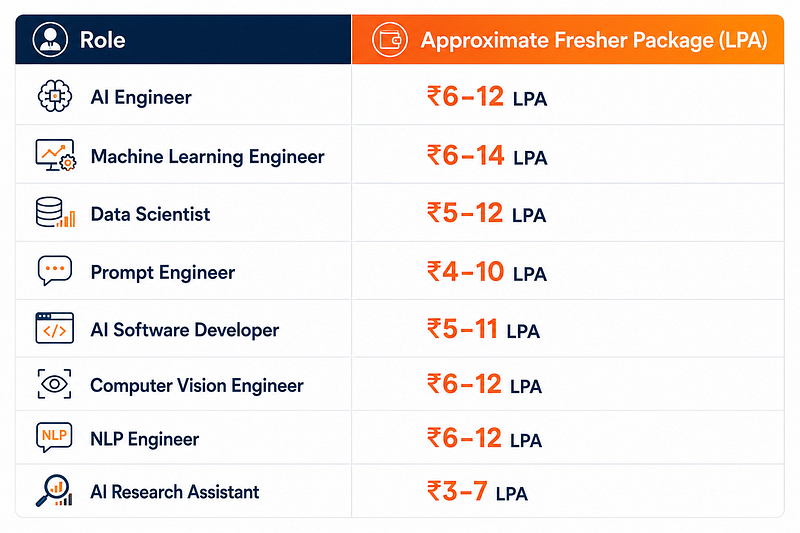 |
| Estimated fresher salary packages for popular AI careers in India, including AI Engineer, Machine Learning Engineer, Data Scientist, Prompt Engineer, Computer Vision Engineer, NLP Engineer, and AI Research Assistant. |
Approximate fresher ranges in India, varying by city, company tier, and portfolio:
Product companies and funded startups pay at the higher end. Service companies start lower but train you in a structure. Treat these as indicative figures, not promises.
Common Mistakes Students Make
- Buying an expensive course in first year, then not opening it
- Skipping Python fundamentals and copying notebooks instead
- Collecting certificates while building nothing
- Leaving GitHub empty, or filling it with unexplained forks
- Letting AI tools write code you cannot defend in an interview
- Chasing AI so hard that the CGPA drops below the placement cut-off
The last one matters more than students expect. Many companies still filter on marks before anyone looks at your projects.
Frequently Asked Questions
1. Which AI course is best for engineering students?
Python for AI first, then machine learning. After that, pick a specialisation matching your branch — computer vision for mechanical, NLP for IT.
2. Can I learn AI without coding experience?
Yes, up to a point. Prompt engineering, AI tool literacy, and visualisation need very little code. Deeper AI roles will eventually require programming.
3. Is Python mandatory for AI?
Practically, yes. R, Julia, and C++ have their uses, but almost every library, tutorial, and job posting assumes Python.
4. Which AI certification has the most value?
Programmes from Google, Microsoft, NVIDIA, DeepLearning.AI, and reputable universities on Coursera or edX are widely recognised — though your portfolio still carries more weight than any certificate.
5. Can AI skills improve campus placement opportunities?
Yes. They strengthen technical rounds, give you specific things to discuss, and make you eligible for roles many classmates cannot apply for.
Conclusion
AI has moved from an optional add-on to a baseline expectation. Choosing carefully among the top AI courses for engineering students — and actually finishing them — gives you an edge in placements, internships, and higher studies that your syllabus alone cannot offer. Start with Python. Add one specialisation that fits your branch. Build two projects you can explain in three minutes. Two consistent semesters are genuinely enough.
For more guidance on branches, colleges, and career skills, explore the engineering resources on CollegePune.
Comments
Post a Comment